
I’ll admit it – I’m artistically challenged.
I was an accountant before I stopped work to travel. I’m great with numbers, I can read a map no matter which way you turn it, and I can organise almost anything.
But ask me to draw something and there’s very little chance you’ll recognise what it is.
So this is probably not going to be your usual MONA review.
I can’t explain the artistic significance of the exhibits, I don’t know much about contemporary art, and quite a few times during my visit I found myself wondering, but why?
And yet, I really enjoyed visiting MONA.
Visiting MONA in Hobart is one of Tasmania’s more unusual museum experiences, and you absolutely don’t need to know anything about art to enjoy a few hours here.
Here’s what it was like visiting MONA as someone who knows almost nothing about art – plus some practical tips to help you plan your own visit.
This article may contain affiliate links. This means that if you make a purchase after clicking on a link, I may receive a small commission. Read the full disclaimer here.

What Exactly Is MONA?
MONA – the Museum of Old and New Art – is a privately owned museum on the banks of the River Derwent, just outside central Hobart.
It was created by Tasmanian David Walsh and opened in 2011. The museum is mostly underground, built into the sandstone beneath the site, which is your first clue that this isn’t going to be a typical art museum.
MONA has a reputation for being provocative, confronting and sometimes downright weird.
Sex and death feature prominently, alongside ancient objects, contemporary artworks, enormous installations and things I still don’t quite know how to describe.
There doesn’t seem to be any expectation that you’ll understand everything you see.
That suited me perfectly.
Getting to MONA

MONA is around 11 km from central Hobart, and there are a few ways to get there, but the most memorable is definitely the MONA ferry.
When I first looked at how to get to MONA, I spotted the ferry – and then looked at the price and wondered if there was a cheaper option.
There was. You can get to MONA by public bus, and driving is also an option.
I was all for saving some money and catching the bus, but I was visiting with a group and everyone else wanted the ferry. So I reluctantly handed over the extra cash.
I’m glad I did.
The MONA experience starts before you even arrive at the museum.
The ferry leaves from Brooke Street Pier on Hobart’s waterfront and takes around 30 minutes along the River Derwent.

And this isn’t your standard commuter ferry.
Ours was decked out in camouflage, with graffiti-covered stairs, sheep that doubled as seats and even a full-sized cow looking out over the river.
Then I ventured onto the front deck and discovered the pink torpedoes. At least, I think we’re supposed to call them torpedoes.

There’s a bar onboard if you want a drink or snack, but I spent much of the trip outside enjoying the views.
If you’re visiting MONA for the first time, I’d choose the ferry over the bus if your budget allows. It costs more, but I think it’s worth considering the ferry as part of the MONA experience rather than simply transport.
Tip: Ferry prices and timetables can change, so check the current options when booking your visit.
What Visiting MONA Is Actually Like
One of the first things you’ll notice at MONA is that there aren’t information panels beside the artworks telling you what you’re looking at.
Instead, MONA uses an app called The O.
Download it to your phone before your visit and, as you move through the museum, it will show you information about the artworks nearby.
And there will probably be quite a lot of wandering.
MONA is mostly underground, and I found it incredibly easy to lose all sense of where I was.
Rather than trying to follow a strict route and make sure you’ve seen absolutely everything, my advice is to just go with it. Wander around, see where you end up and ask one of the staff if you think you’ve missed an entire section.
You probably have.
Some experiences and artworks may require separate bookings or have limited capacity, so check The O during your visit to see what’s available.
Sometimes I liked something simply because it looked good. Sometimes an artwork made me stop and think. And sometimes my reaction was simply, that’s weird.
For me, that unpredictability was a big part of the fun.
Some of the Artworks I Saw at MONA
MONA’s displays change regularly, so you may not see all – or even many – of the artworks I saw during my visit.
But these will give you an idea of just how varied, unusual and sometimes completely baffling the MONA experience can be.
These aren’t art critiques. They’re simply what I saw and what I thought about them at the time.

Your Shadow Rising
This was a hanging glass hand illuminated so that it created reflections and rainbows as the light passed through it.
I liked the overall effect.
Was it meant to represent something deeper? Probably.
Did I know what that was? Absolutely not.

Untitled (White Library)
As someone who loves books and libraries, this one immediately caught my attention.
The shelves were filled with what looked like ordinary white books, except every single one was completely blank.
What was the point?
I have no idea. But I was intrigued enough to spend some time looking at it, which perhaps was the point.

Weight of Darkness
This was one of the more memorable experiences of my visit.
We entered a room in almost total darkness and made our way across uneven stepping stones surrounded by black water to reach a platform containing a sarcophagus.
After carefully navigating my way there, I remember reaching the platform and thinking…
Is that it?
The journey through the darkness was certainly more memorable to me than what I found at the end.

This is Tim
Now this one is a bit weird.
Tim is a real person whose back has been tattooed by Belgian artist Wim Delvoye. The artwork, called Tim, was sold to a collector, with Tim essentially becoming the custodian of the artwork on his own body.
When Tim dies, the tattooed skin is to be removed and preserved for its owner.
Yes, really.
When we visited, Tim was sitting there with his back to us, displaying the artwork.
I couldn’t help thinking this must surely be one of the most boring jobs in the world.
My main question was much more practical.
What happens when he needs to go to the loo?

Stemenfall
This was another one involving books – or possibly newspapers. I wasn’t entirely sure.
They were made from lead with pieces of glass between them and looked rather neglected and sad.
Post-apocalyptic, perhaps?

Pigment Bleu Sec
This one looked deceptively simple – an expanse of sand completely covered in brilliant blue pigment.
We got chatting to the staff member watching over it, who told us they used a special machine to fluff up the surface regularly to maintain its smooth, velvety appearance.
Our conversation came to an abrupt end when a small child made a beeline towards the irresistible bright blue surface.
The staff member moved very quickly.

The Grotto
Finally, one I understood.
Well, perhaps I didn’t understand the art, but I definitely understood the appeal.
The Grotto was a room filled with soft, foamy shapes that you could sit in. Shoes came off and we settled into the curves for a rest.
I found it at exactly the right point in our visit and sat there with a few friends for so long that Simon, who hadn’t joined us, thought I’d fallen asleep.
Sometimes art just needs to provide a comfortable seat.

Fat Car
This is pretty much what the name suggests – a Porsche that looks like it has been inflated.
My artistically challenged interpretation was that perhaps it was saying something about consumerism and excess.
Or perhaps not.
Mostly, I thought it looked kinda cute.

Cunts and Other Conversations
This is one of MONA’s more famous – and confronting – artworks.
Created by Greg Taylor, it consists of a long line of porcelain casts of vulvas displayed at eye level along the wall.
It’s certainly not subtle.
I didn’t find it offensive, but I also didn’t really understand why it was art or what I was supposed to take away from it.
Sometimes your reaction to an artwork might simply be, Why?

Cloaca Professional
Better known as the poop machine, Cloaca Professional is exactly as strange as it sounds.
The machine mimics the human digestive system. It is fed food, processes it through a series of glass vessels and eventually produces… well, poop.
Unfortunately – or perhaps fortunately – we managed to miss the main event during our visit.
Scientifically, I can see how the whole process is quite interesting.
But part of me still thinks it sounds like the sort of thing a teenage boy would find hilarious.

Bottle Smashing Room
I actually quite liked this one.
We walked through a darkened room filled with broken glass, with the light reflecting off the pieces and making the whole thing surprisingly beautiful.
Later, we suddenly heard huge smashing sounds and discovered visitors were throwing glass bottles onto the pile.
We couldn’t stay and watch, but it struck me as one of those strangely mesmerising things you could watch for far longer than you intended.

BIT.FALL
This was another favourite.
BIT.FALL looks a little like a waterfall, except words appear briefly in the falling water before disappearing.
When we visited, the words were generated from information being gathered online, connecting the constantly changing artwork with what was happening in the world outside.
We were there on Remembrance Day and at one point the word “remembrance” appeared in the water.
I’d seen similar water displays elsewhere, but the constantly changing words made this one particularly interesting to watch.

20:50
This one assaulted more than just the eyes.
20:50, by British artist Richard Wilson, appears to be an enormous dark, perfectly reflective pool.
It’s actually filled with recycled engine oil.
The surface is so still that it acts like a mirror, and you can get surprisingly close to the oil, which means you’re not only seeing the artwork – you’re smelling it.
It was certainly one of the more memorable installations we encountered.
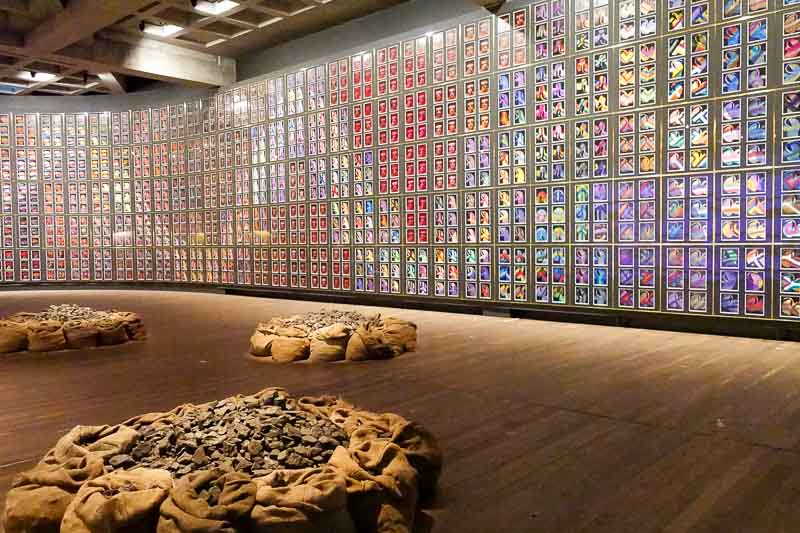
Snake
Now this one really did impress me.
Sidney Nolan’s enormous Snake is made up of 1,620 individual painted panels which, when displayed together, form a huge snake stretching across the wall.
The scale of it is difficult to appreciate until you’re standing in front of it.
I simply thought it was impressive.

Queen (A Portrait of Madonna)
In another room we found a wall of screens showing different people singing Madonna songs.
Together, they perform the entire Immaculate Collection album a cappella.
It doesn’t necessarily sound like something you’d spend much time watching.
Except we did.
We stood there through a couple of songs and I was even tempted to pop back in when we passed the room again later.

The Fornicating Skeletons
I didn’t write down the name of this artwork, so I’m sticking with the highly descriptive name I gave it at the time: the fornicating skeletons.
And yes, they’re doing exactly what you think they’re doing.
They’re not static either. The skeletons move, accompanied by a screen showing the action during the performance.
It’s weird, slightly ridiculous and very MONA.
I’ll leave it at that.

The Trampoline Outside
The art doesn’t stop when you leave the building.
Outside we found what looked like a trampoline, except jumping on it caused the large bells nearby to ring.
Adults as well as kids could have a go, so naturally there were plenty of grown-ups bouncing around too.
After spending hours looking at art you’re not entirely sure you understand, being able to jump on something and make a lot of noise felt strangely appropriate.
Eating and Drinking at MONA

You could easily spend several hours at MONA, so there’s a good chance you’ll want something to eat or drink while you’re there.
We stopped at Faro, MONA’s restaurant overlooking the River Derwent. It’s at the more expensive end of the options, but the location makes it a lovely place to stop during your visit.
There are other places to eat and drink around the MONA site too, so you don’t necessarily need to commit to a full restaurant meal.
MONA is also home to Moorilla winery and Moo Brew, so there’s plenty here beyond the museum itself if you’d like to make a longer day of it.
How Long Do You Need at MONA?
I’d allow at least half a day for MONA.
We spent an afternoon here and that gave us plenty of time to explore, although I could easily have stayed longer.
If you’re taking the ferry, stopping for lunch or a drink, visiting the winery or simply like taking your time, you could make MONA the main activity for the day.
My advice is not to try to see absolutely everything.
See what catches your attention, linger when you find something interesting and move on when you don’t.
You don’t get extra points for understanding it all.
Trust me.
Is MONA Suitable for Children?
Children can visit MONA, but this isn’t necessarily your typical family-friendly museum.
Some of the artworks contain nudity, sexual themes, violence or other confronting material.
Whether that’s suitable for your children will depend on their age and what you’re comfortable with them seeing. You may also find yourself answering some interesting questions.
If you’re visiting with children, check The O as you go, as it includes information about potentially confronting content.
I wouldn’t automatically rule out MONA as a family activity – I’d just go knowing that this isn’t a conventional museum.
Is MONA Worth Visiting If You Don’t Like Art?
I think so – and I’m probably a pretty good test case.
I wouldn’t normally put an art museum at the top of my list when visiting a new city. I did, after all, once go all the way to Paris and not even go inside the Louvre.
I certainly don’t have the knowledge to stand in front of an artwork and discuss its technique, meaning or significance.
But MONA isn’t really like visiting a traditional art gallery.
It’s an experience.
There’s the ferry ride, the underground setting, the strange layout and the sheer unpredictability of what you’ll find around the next corner.
Some things made me laugh. Some impressed me. Some confused me.
But very little of it was boring.
You don’t need to know anything about art before you visit MONA, and you don’t need to come away understanding everything you’ve seen.
Years later, I can still remember many of the artworks I saw there.
For someone who is artistically challenged, I reckon that’s a pretty good recommendation.
MONA Tickets, Opening Hours and Booking
MONA is currently open from Thursday to Monday, 10 am to 5 pm, and closed on Tuesdays and Wednesdays. Opening days and hours can change at different times of the year, so check before your visit.
At the time of writing, general admission for visitors from outside Tasmania is $39 for adults, $33 concession and $17 for those aged 12–17. Children under 12 enter free.
Tasmanian residents can visit MONA for free, although they still need to book a ticket and show suitable ID.
I recommend booking your museum ticket in advance. MONA uses timed entry and popular sessions can fill up.
Some special artworks and experiences require a separate ticket, and the MONA ferry is also separate from museum admission.
Tip: Prices, opening hours and exhibitions can change, so check the latest information when you’re planning your visit.
Final Thoughts on Visiting MONA
MONA is weird, confronting, confusing and occasionally completely ridiculous.
And I really enjoyed it.
I went in knowing almost nothing about art and came out knowing… well, probably not much more about art.
But that didn’t matter.
MONA made me look, laugh, question things and occasionally stand in front of something wondering how on earth someone came up with the idea in the first place.
Years later, I can still remember an extraordinary number of the artworks I saw – and I can’t say that about many art museums I’ve visited.
Would I visit MONA again?
Absolutely.
The displays change, so a future visit could be quite different to mine. Next time I’d probably allow even more time to wander, get lost and see what strange things MONA has come up with.
You don’t need to understand art to enjoy MONA.
Sometimes it’s enough for an artwork to make you stop and think – even if it’s all done in a haze of confusion.
You might also enjoy these posts to help with your Tasmanian holiday
Day Trip from Hobart to Richmond, Tasmania
A Port Arthur Day Trip from Hobart, Tasmania
Finding the best Hobart Street Art
Liked this post? Share it with your friends or pin for later.


I had a Moo Brew. I thought it was the best part of my visit.
Yes, art should challenge and spark discussion, but I thought most of it was too “clever-clever” for my taste. The site and the labyrinthine building was interesting.
I enjoyed the ferry ride too.
Will I return? Unlikely.
You seem to have found bits that I didn’t. Like about three quarters of the photos are of things I didn’t get around to seeing.
You know, when I was looking online for the names of some of the pieces that I hadn’t remembered, I saw so many photos – and recent ones too – of things I didn’t see. I thought maybe they just changed things around a lot, but it is so maze-like, I’m sure I didn’t go everywhere! Glad to hear I’m not the only one who missed some bits.
I agress – I see a couple of artworks here that I don’t remember seeing in person. I must have missed them, even though I had a (very vague and undetailed) map in hand. The layout was very confusing!
Gosh, seems to be a common occurrence then! Maybe it’s a ploy to get us all to go back again.
What you didn’t mention about the O is that your journey around MONA can be saved for later review. You provide an email address and, later, you will be emailed a link and you can revisit your time at MONA and all of the exhibits you visited.
Thanks Heather. Yes, I noticed that feature but didn’t use it, so I completely forgot about it when I was writing.
The ferry might be pricey but it looks like no other ferry I have seen and the museum looks pretty good too!
Thanks Catherine. the ferry and museum are both definitely unique!
Great post! Even if you feel you don’t understand art, it’s great to read a post from the visitors perspective in regard to object labels (or lack thereof) and flow through the gallery spaces. I actually have never visited MONA, but I did visit the site (and winery) before it was built in 2006. Such a magical location.
Thanks Alison. I think MONA is fairly unique. I’ve been to lots of museums around the world, and I’ve not seen anywhere else quite like this one.
I agree Josie, being a Dutchman I have visited many museums in the Netherlands & elsewhere in the world.
Mona is definitely the best museum in Australia & no doubt one of the best in the world.
The Cloaca machine is one of my favourite pieces of art by Belgian Wim Delvoye. For years I have supplied Mona for this apparatus the Caustic Soda( NaOH) and Hydrochloric Acid(HCl) for the digestive process of food.
Thank you for your great post for many to be enjoyed.
Best regards, Henk
Thanks so much Henk. It’s nice to know other people can have a sneak peek of MONA before they get there. Hopefully, it will help convince a few people to add it to their travel plans.