

I’ve driven between Adelaide and Sydney a few times now, and Hay has become my preferred place to stop overnight along the way.
And after several stays, I’ve discovered there are more things to do in Hay than you might expect.
Sitting on the vast Hay Plains in western New South Wales, it’s roughly halfway between the two cities and makes a practical place to break up the long drive.
But rather than arriving late and leaving first thing the next morning, I like to give myself a little time to explore.
On one trip, while travelling across to climb Mount Kosciuszko, I arrived with plenty of daylight left and headed out to see what I could find.
Since then, I’ve stayed in Hay several times and discovered more of the town along the way.
There’s an interesting mix of museums, local history, public art and outdoor attractions, and you can see quite a lot even if you’re only stopping overnight.
Hay Shire is on the traditional Country of the Nari Nari, Wiradjuri and Yitha Yitha peoples.
This article may contain affiliate links. This means that if you make a purchase after clicking on a link, I may receive a small commission. Read the full disclaimer here.
Watch the Sunset Over the Hay Plains

One of my favourite things to do in Hay is also one of the simplest – drive out onto the Hay Plains and watch the sunset.
I first discovered the Sunset Viewing Area after seeing a sign for it in town. The landscape around Hay is incredibly flat, so I wondered what exactly made this particular spot a “viewing area”.
It turns out you don’t need a hill when there’s almost nothing to block the horizon.
The viewing area is 16 km north of Hay on the Cobb Highway towards Booligal. It’s essentially a parking area beside the road, with some quirky sculptural seating and uninterrupted views across the plains.
It’s free, always open and worth timing your visit for sunset. Take something to drink, sit back and watch the colours change across the huge sky.
There’s also a Long Paddock information panel here, which is a nice introduction to another part of Hay’s story.
See the Hay Water Tower Art

Hay might not have the huge painted grain silos found in some Australian country towns, but it does have two impressive painted water towers.
Melbourne artist Matt Adnate transformed the towers in 2020 as a tribute to the servicemen and women from Hay who served during World War II.
The portraits depict five local veterans – Norman Charles Flack, William “George” Cannon, Victor George Murray, Clifford Leslie Farlow and Australian Army Nursing Service Lieutenant Lorna Margaret Whyte.
Information panels at the site tell you more about the people featured in the artwork.
You’ll find the Hay Water Tower Art on the corner of Pine and Brunker Streets. It’s free and an easy stop while exploring town.
Visit the Dunera Museum

One of the most interesting parts of Hay’s history is its role as an internment and prisoner-of-war centre during World War II.
The Dunera Museum, located at the old Hay Railway Station, tells the story of the people held in camps around Hay between 1940 and 1946.
Perhaps the best known were the “Dunera Boys”. Almost 2,000 mostly German and Austrian refugees, many of them Jewish and fleeing Nazi persecution, were transported from Britain to Australia aboard the HMT Dunera. They arrived in Hay on 7 September 1940.
Their story is only part of Hay’s wartime history. More than 6,000 German, Italian and Japanese civilian internees and prisoners of war were held in three camps around Hay during the war years.
Photographs, documents and personal stories help explain what happened here and what life was like for the internees and the local community.
If you’re interested in Australian or World War II history, I’d put this high on your list.
The Dunera Museum is at the Hay Railway Station on Murray Street and is open seven days a week. There is a small admission charge.
Visit the Hay War Memorial High School Museum
Hay has an unusual approach to remembering the local men and women who served during World War I – the town built a school as its war memorial.
Hay War Memorial High School opened on Anzac Day in 1923 as a living memorial, providing educational opportunities for future generations rather than building a more conventional monument.
The museum tells the stories of people from Hay and the surrounding district who served in conflicts from the Boer War onwards, as well as the history of the school itself.
The museum is within a functioning school, so check current opening arrangements before visiting.
Explore the Hay Gaol Museum
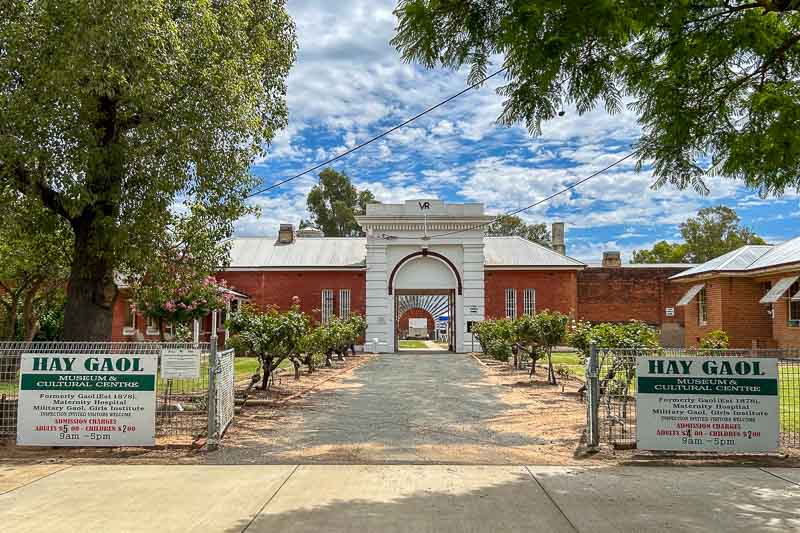
Hay Gaol has had quite a few different lives since it was built in the late 1870s.
It began as a prison but has also been used as a prisoner-of-war facility during World War II, a maternity hospital and an institution for girls. Since 1976, it has been home to the Hay Gaol Museum.
You can explore the old cells and buildings while learning about the people who passed through them. The collection also covers Hay’s broader social and pastoral history and includes everything from antique windmills to what is believed to be Australia’s oldest known bark canoe.
Hay Gaol Museum is on Church Street and is currently open seven days a week from 9 am to 5 pm. Allow around an hour to look around.
Visit Shear Outback

Shear Outback is one of Hay’s best-known attractions, and this one has a particular connection for me.
I grew up on a wheat and sheep farm, and shearing was my absolute favourite time of year. I loved the activity in the shearing shed, so this brings back plenty of memories.
Shear Outback is home to the Australian Shearers’ Hall of Fame and a museum exploring the history of shearing and Australia’s wool industry.
Try to time your visit for one of the live shearing demonstrations in the historic Murray Downs Woolshed. The woolshed was relocated here from Victoria, and the demonstration covers shearing, wool classing, different types of sheep and the equipment used by shearers.
Demonstrations currently run daily at 10:30 am and 1 pm, although times can change in extreme weather.
Allow at least 90 minutes for the museum and demonstration. There’s also a café on site.
Shear Outback is at the junction of the Sturt and Cobb Highways, making it an easy stop as you arrive in or leave Hay.
Visit Bishop’s Lodge Historic House
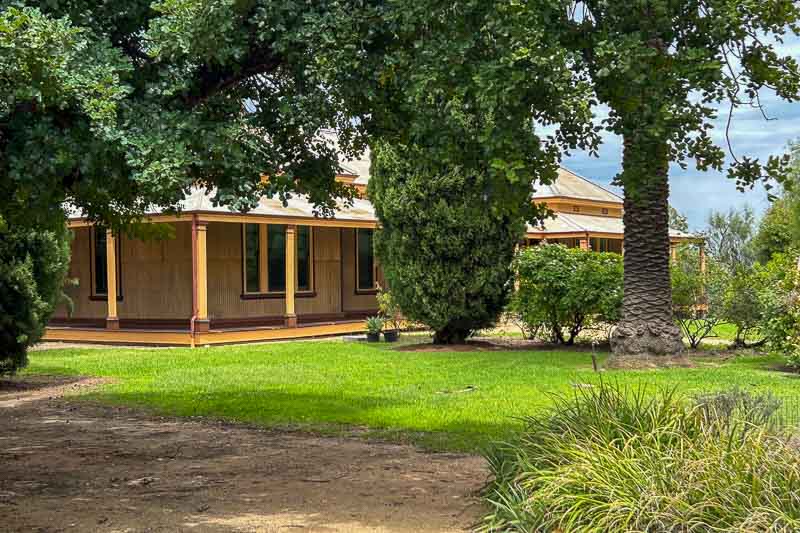
Bishop’s Lodge was built in 1888–89 as the residence of the first Anglican Bishop of Riverina, Sydney Linton.
Designed by architect John Sulman together with Bishop Linton, the house was built to cope with Hay’s hot summers and difficult soils.
Much of it is constructed from corrugated iron, while clever ventilation and insulation techniques were used to make life inside more comfortable.
You can take a self-guided look through the house and wander through the gardens, which are known for their collection of heritage roses.
Bishop’s Lodge is on Roset Street, just off the Sturt Highway.
Find the Sculptures on Lachlan Street

While walking through central Hay, look out for a couple of quirky sculptures outside the Hay Shire Council Chambers on Lachlan Street.
One depicts local identity Mrs Mary McGrath with two of her pet sheep, which regularly accompanied her around town.
Nearby, another sheep is sitting down reading The Riverine Grazier, Hay’s local newspaper.
Both sculptures were created by artist John Wood and are a fun little stop as you explore the main street.
Follow the Hay Heritage Walk

Another easy way to explore central Hay is to follow the self-guided Hay Heritage Walk.
The route takes you past historic buildings including the Hay Post Office, courthouse, churches, old hotels and commercial buildings along Lachlan Street, with interpretive signs explaining some of their history.
You don’t necessarily need to follow the entire route. If you only have an hour or two, pick up the heritage information from the Hay Visitor Information Centre and incorporate part of the walk into your wander around town.
Spend Some Time by the Murrumbidgee River
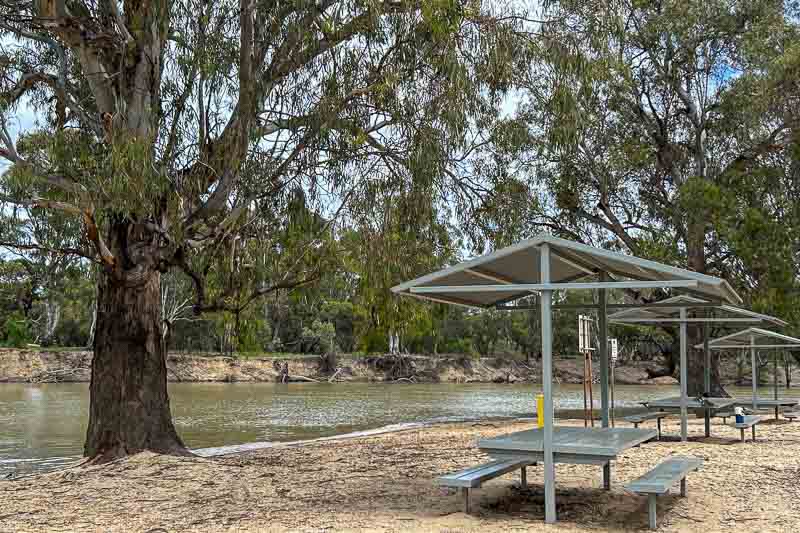
After hours of driving across the Hay Plains, the Murrumbidgee River is a welcome change of scenery.
One of the easiest places to enjoy it is Sandy Point Reserve, just a few minutes from the centre of town. There are picnic facilities, toilets and river access, and depending on the river level, you may even find a sandy beach along the bank.
It’s a popular spot for fishing, swimming and launching kayaks and canoes, although river conditions can change, so check locally before getting into the water.
Even if you’re only stopping briefly, it’s a pleasant place for a wander beneath the river red gums.
Walk or Cycle the Bidgee Riverside Trail

The Bidgee Riverside Trail follows the Murrumbidgee River through Bushy Bend Reserve towards Sandy Point, making it easy to combine with a visit to the river.
Along the way, look out for large sculptures by artists John Wood and John Woodward.
You can walk the trail or borrow one of the bikes available for free from the Hay Visitor Information Centre. Pick up a cycling map while you’re there and you can combine the riverside trail with several other attractions around town.
Learn About the Long Paddock

Hay sits on the Long Paddock Touring Route, which follows 610 km of the Cobb Highway from Echuca-Moama to Wilcannia.
The route follows historic travelling stock routes once used by drovers moving sheep and cattle across inland Australia – and parts are still used for travelling stock today.
If you’re driving north from Hay towards Booligal, look out for interpretive panels telling stories about drovers, pastoral life and the communities scattered across the plains. One is at the Sunset Viewing Area, 16 km from Hay.
Further north, around 38 km from Hay, is the historic One Tree Hotel. Built in 1862, it became a staging post for Cobb & Co coaches and served travellers crossing the plains. It hasn’t operated as a hotel since the 1940s, but the isolated building makes an interesting roadside stop.
If You Have More Time: Visit Maude or Booligal

If you’re staying in Hay for more than one night, you could venture further out onto the plains.
Maude is around 50 km west of Hay on the Murrumbidgee River. Stop at the Maude Hotel, take the short Meandering Maude Walking Trail or spend some time around the river and Maude Weir.
Booligal is around 79 km north of Hay along the Cobb Highway. The tiny village sits beside the Lachlan River and is best known for its connection with Banjo Paterson’s poem Hay and Hell and Booligal.
There’s not a long list of attractions in either town – that’s really the point. They offer a glimpse at some of the tiny communities scattered across this part of New South Wales.
I wouldn’t make the drive specifically for either if you only have an overnight stop in Hay, but they’re worth considering if you have more time or are travelling onwards in that direction.
Getting to Hay
Hay sits in western New South Wales at the junction of the Sturt, Cobb and Mid-Western Highways.
It’s around 650 km from Adelaide and 720 km from Sydney, making it a useful overnight stop when driving between the two cities. That’s exactly how I first came to know Hay.
From Adelaide, the Sturt Highway takes you through Mildura and Balranald before reaching Hay.
Hay is also on the Cobb Highway, which runs north towards Booligal and Wilcannia and south towards Deniliquin and Echuca-Moama.
Don’t underestimate the distances out here. There are long stretches between towns, so I like to fill up when I have the opportunity rather than waiting until the fuel gauge gets too low.
Once you arrive, Hay itself is compact and easy to explore by car, on foot or by bike.
Where to Stay in Hay

There are plenty of places to stay in Hay, from camping along the river to motels and self-contained accommodation around town.
For my overnight stops, I’ve stayed at the Commercial Motel.
I’m not looking for anything fancy when I’m breaking up the long drive between Adelaide and Sydney. I want somewhere clean and comfortable, in a convenient location and at a reasonable price – and the Commercial Motel has worked well for me.
The building was once the Commercial Hotel, but the pub has closed and it now operates as accommodation. The rooms are fairly basic but have everything I need, including a private bathroom, TV, free Wi-Fi, microwave, fridge and kettle.

There’s also a simple continental breakfast available, which is handy when you want to get back on the road in the morning.
Some upstairs rooms open onto the long balcony overlooking Lachlan Street, and I’ve enjoyed sitting out there at the end of the day.
I’ve stayed here twice, and my husband has stayed another time. For a straightforward overnight road-trip stop, we’ve found it good value for money.
There are designated pet-friendly rooms, but confirm that you’ve booked one if you’re travelling with a pet.
Click here to check prices & availability for your trip.

Is Hay Worth Stopping For?
Hay might initially look like somewhere to refuel, grab some food and keep driving, but I think it’s worth allowing a little extra time here.
I originally chose Hay because it was a convenient overnight stop between Adelaide and Sydney. After several stays, I’ve discovered there’s much more to the town than I expected.
You don’t necessarily need an extra day. Arrive a few hours earlier, choose a couple of things that interest you and finish the day watching the sunset over the Hay Plains.
It certainly makes an overnight road-trip stop a lot more interesting.
Before you go…try these posts
20 Places to Experience the Australian Outback
23 Hidden Gems in Sydney
Crossing the Nullarbor
TRAVEL PLANNING ESSENTIALS
Flights – Book direct with the airline, always.
Book accommodation – My go to is Booking.com
Hire a rental car – DiscoverCars.com is where I search many car rental companies in one place
Get travel insurance – I use CoverMore for my insurance.
Pick up an eSIM – My eSIM of choice is Airalo
Book activities, tours & attractions – I use a few different websites for this. Viator, Get Your Guide and Klook are my first options.
Stay safe with a VPN – I use NordVPN to keep me safe online
Manage your money – I use Wise and ING (Australia) for my travel accounts.
Found this post useful? Share with your friends and pin for later

