

Melbourne isn’t exactly known for being a cheap city, but that doesn’t mean you need to spend a fortune to enjoy it. In fact, there are plenty of free things to do in Melbourne, including some of the city’s best-known attractions.
I’ve been visiting Melbourne regularly for decades, and it’s one of those cities where I always seem to find something new to see or do. Even after many visits, I can happily spend a day wandering the laneways, visiting a gallery or museum, checking out what’s happening around Federation Square or simply exploring a different part of the city.
So if you’re visiting Melbourne on a budget – or you just like saving your money for the things that are worth splurging on – here are 30 free things to do in Melbourne.
This article may contain affiliate links. This means that if you make a purchase after clicking on a link, I may receive a small commission. Read the full disclaimer here.
Free Things to Do in Melbourne CBD
If you’re staying in central Melbourne, you’re in luck. Many of Melbourne’s best free attractions are within walking distance of each other, and the Free Tram Zone makes it easy to get around those that are a little further apart.
1. Explore Federation Square
Right opposite Flinders Street Station, Federation Square is one of the easiest places to start exploring Melbourne.
There’s usually something going on here, from events and exhibitions to live broadcasts on the big screen, and it’s also home to several attractions on this list, including ACMI, the Ian Potter Centre and the Koorie Heritage Trust.
Even if nothing special is happening, it’s worth having a look around. The architecture has divided Melburnians since Federation Square opened in 2002, so you can decide for yourself what you think of it.
It’s also a handy meeting point and a good place to sit for a while and watch Melbourne go by.
2. Visit ACMI

If you’re interested in movies, television, video games or digital culture, make time for ACMI at Federation Square.
Entry to ACMI itself is free, including its permanent exhibition, The Story of the Moving Image. It covers everything from the early days of film and television through to video games and modern digital media.
There are plenty of interactive displays, so this isn’t the sort of museum where you simply walk past rows of objects in glass cases.
ACMI also holds temporary exhibitions, screenings and events. Some of these have an admission charge, so check what’s on before your visit if there’s something in particular you want to see.
3. See Australian Art at the Ian Potter Centre

Also at Federation Square, the Ian Potter Centre is part of the National Gallery of Victoria and focuses on Australian art.
The collection includes works by First Nations and non-Indigenous Australian artists, ranging from colonial works through to contemporary art.
General entry is free, although there may be a charge for some special exhibitions.
It’s easy to combine the Ian Potter Centre with ACMI and the other attractions around Federation Square, making this one of the best parts of Melbourne to visit when you want to fill a few hours without spending anything.
4. Visit the National Gallery of Victoria

Across the river on St Kilda Road is NGV International, the other main part of the National Gallery of Victoria.
The NGV is Australia’s oldest and most visited art museum, and its permanent collection is free to visit.
You’ll find art and design from around the world, including European, Asian, Oceanic and American works. Even if you’re not usually someone who spends hours in art galleries, it’s worth popping inside to see the building itself and the famous stained-glass ceiling in the Great Hall.
Some of the NGV’s major temporary exhibitions are ticketed, but you can see a substantial amount without paying anything.
5. Discover the Australian Music Vault
This is one I think a lot of visitors to Melbourne overlook.
The Australian Music Vault is a free exhibition at Arts Centre Melbourne celebrating the history of Australian contemporary music.
There are costumes, instruments, photographs, recordings and memorabilia from Australian musicians, along with interactive displays and stories covering different eras of Australian music.
If you grew up listening to Australian music, expect to recognise plenty of names along the way. You’ll find everyone from AC/DC and Kylie Minogue to Archie Roach and many other Australian artists represented.
Entry to the Australian Music Vault is free, making it an easy addition while you’re exploring the Arts Centre, NGV and Southbank area.
6. Visit the State Library Victoria
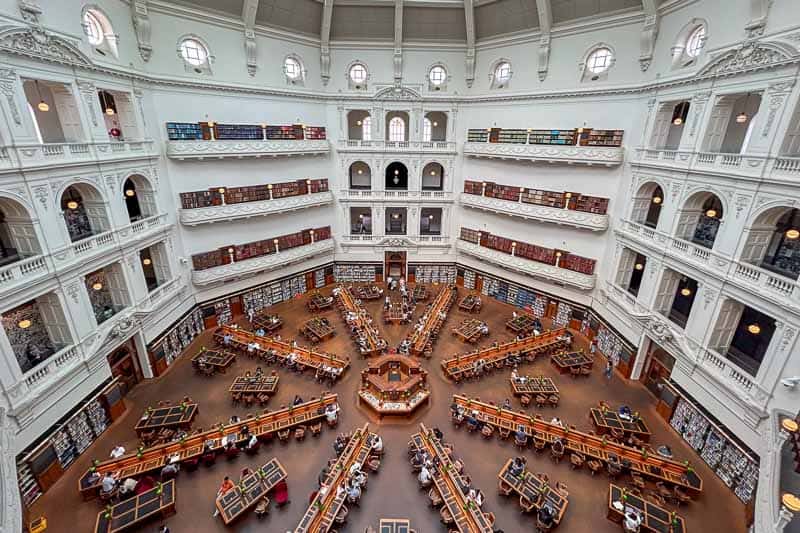
The State Library Victoria is much more than somewhere to go and read a book. It’s one of Melbourne’s most beautiful public buildings and well worth visiting even if you have no intention of picking up a book.
The highlight for most visitors is the huge domed La Trobe Reading Room. Head upstairs to one of the viewing balconies for the classic view down over the desks below.
There are also free exhibitions throughout the library, including displays from its collections covering Victoria’s history and culture.
The library is right in the centre of Melbourne, opposite Melbourne Central, so it’s an easy one to add while you’re exploring the CBD.
7. Explore Melbourne’s Street Art

Melbourne is famous for its street art, and you don’t have to wander far through the CBD before you find it.
Hosier Lane, opposite Federation Square, is the best-known spot, but don’t stop there. AC/DC Lane, Duckboard Place and many of the smaller lanes around the city are also worth exploring.
The great thing about Melbourne’s street art is that it’s constantly changing. I’ve visited the same lanes many times over the years and they never look exactly the same.
You can simply wander and see what you find, or follow one of the City of Melbourne’s self-guided street art walks.
8. Wander Through Melbourne’s Laneways and Arcades

Street art is only one reason to explore Melbourne’s laneways. Some are packed with tiny cafes, restaurants and shops, while others lead to beautiful historic arcades you might easily walk straight past.
Make sure you take a look inside the Block Arcade and Royal Arcade. Both date from the nineteenth century and are worth visiting for the architecture alone – although there are plenty of opportunities to spend money once you’re inside!
Then wander through some of the smaller lanes around the CBD and see where you end up. Part of the fun of exploring Melbourne is finding places you weren’t actually looking for.
9. Browse Queen Victoria Market

You don’t have to buy anything to enjoy a wander through Queen Victoria Market.
The market has been operating since 1878 and covers several city blocks, with stalls selling fresh produce, deli foods, clothing, souvenirs and all sorts of other things.
It’s a great place to wander, browse the stalls and soak up some of Melbourne’s atmosphere. Of course, whether you manage to walk past all that food without buying anything is another question.
There are also events and seasonal markets held here throughout the year, so it’s worth checking what’s happening during your visit.
10. Learn About First Nations Culture at Koorie Heritage Trust

Back at Federation Square, the Koorie Heritage Trust is a great place to learn more about the cultures and histories of Aboriginal people from south-eastern Australia.
The centre has exhibitions featuring Aboriginal art, artefacts and stories, with a particular focus on the Koorie people of Victoria.
Entry to the exhibitions is free, and it’s worth allowing some time rather than simply popping in for a quick look.
The Koorie Heritage Trust also offers guided cultural walks around central Melbourne. These have a fee, but the exhibitions and cultural centre can be visited for free.
11. Take a Free Tour of Parliament House

You can visit one of Melbourne’s most impressive buildings without paying a cent.
Parliament House has been home to the Parliament of Victoria since 1856 and also served as Australia’s first Federal Parliament House from 1901 until 1927, while Canberra was being established as the national capital.
Free public tours are available on selected weekdays when Parliament is not sitting. You’ll get to see inside areas such as the Legislative Assembly and Legislative Council chambers and learn more about the building and Victoria’s parliamentary history.
Tour availability can change depending on parliamentary business, so check the Parliament of Victoria website before you go.
12. Tour Melbourne Town Hall
Another building you can see for free is Melbourne Town Hall on Swanston Street.
The Town Hall has been at the centre of Melbourne civic life since the nineteenth century and has hosted everyone from royalty and politicians to musicians and celebrities.
Free guided tours take you behind the scenes into parts of the building you wouldn’t normally get to see. Depending on access on the day, this can include the Council Chambers, function rooms and the famous portico balcony.
That balcony has a particularly fun piece of Melbourne history attached to it – thousands of people packed Swanston Street when The Beatles appeared there during their 1964 Australian tour.
Places on the free tours are limited, so book ahead if you’d like to do this one.
13. Visit the Old Treasury Building
At the top end of Collins Street, the Old Treasury Building is another of Melbourne’s impressive nineteenth-century buildings.
It was built during Victoria’s gold rush years, when huge amounts of gold were being discovered and Melbourne was rapidly becoming one of the wealthiest cities in the world.
Today, the building contains free exhibitions about Melbourne and Victoria’s history. You can also see the original gold vaults beneath the building, which were once used to store gold bullion.
General admission is free, although opening days and hours are limited, so check before making a special trip.
14. Visit Melbourne’s Cathedrals and Historic Churches

Melbourne has some beautiful churches that you can visit for free, even if you’re not religious.
St Paul’s Cathedral is the easiest to include while sightseeing because it’s directly opposite Flinders Street Station and Federation Square. Step inside to see its Gothic Revival interior, stained glass and impressive organ.
A little further away is St Patrick’s Cathedral in East Melbourne, one of the city’s most striking nineteenth-century buildings and the largest church building in Australia.
You could also stop at St Francis’ Church on Lonsdale Street. Dating back to the 1840s, it’s one of the oldest surviving buildings in central Melbourne.
Remember that these are active places of worship rather than tourist attractions, so be respectful if a service is taking place.
15. Ride the City Circle Tram

Melbourne’s City Circle Tram is one of those rare tourist attractions that’s genuinely useful as well as free.
Route 35 travels around the edge of Melbourne’s CBD and Docklands, passing many of the city’s major sights along the way. The heritage-style trams make it particularly popular with visitors.
You don’t need a myki card to ride the City Circle Tram, and you can hop on and off as often as you like.
It’s a good option if your feet need a break after a day of sightseeing, but I wouldn’t use it purely as transport if you’re in a hurry. The route is designed for sightseeing and takes a longer way around the CBD than many regular trams.
And don’t confuse the City Circle Tram with Melbourne’s Free Tram Zone – that’s next.
16. Travel Around Melbourne in the Free Tram Zone
You don’t have to stick to the City Circle Tram to travel around central Melbourne for free.
Melbourne has a Free Tram Zone covering much of the CBD and Docklands. As long as your entire journey stays within the zone, you don’t need to tap on with a myki or pay a fare.
The stops within the Free Tram Zone are clearly marked, and announcements on board let you know when the tram is about to leave the zone.
This makes it incredibly useful for sightseeing. You can use regular trams to travel between many of the places on this list, including Queen Victoria Market, Federation Square, Parliament House and Docklands.
Just be careful when travelling towards attractions outside the CBD. St Kilda, for example, is not within the Free Tram Zone, so you’ll need a valid myki once you travel beyond the boundary.
17. Explore Melbourne With a Local Greeter
If you’d like someone local to show you around Melbourne, the Melbourne Greeter Service is one of the best freebies in the city.
The free walks are led by volunteers who know Melbourne and can introduce you to some of the city’s landmarks, laneways and stories along the way.
Unlike the “free” walking tours you might see advertised in many cities, where you’re expected to tip your guide at the end, the Melbourne Greeter Service is genuinely free.
The walks can take a few hours, so allow a decent chunk of your day. Numbers are limited and arrangements can change, so check the City of Melbourne website for current availability and booking information before your visit.
18. Take Yourself on a Self-Guided Melbourne Walk
Prefer exploring at your own pace? Take yourself on one of Melbourne’s self-guided walks.
The City of Melbourne has put together a range of walks covering different parts of the city and different themes. You can choose from walks focusing on Melbourne’s street art, music, history, gardens and the Yarra River.
This is a good option if you’re trying to keep costs down because you still get some background about what you’re looking at without paying for a guided tour.
It’s also perfect if, like me, you’re constantly stopping to take photos and don’t necessarily want to keep up with a group.
19. Visit the Victoria Police Museum
For something a little different, visit the Victoria Police Museum.
The museum explores the history of policing and crime in Victoria through photographs, documents, uniforms, equipment and objects connected with some of the state’s best-known criminal cases.
There’s plenty of social history here too, so you don’t need to be particularly interested in policing to find it interesting.
Entry is free. Check the current opening days and hours before visiting, as this isn’t an attraction that’s necessarily open every day.
20. Have a Look Inside narrm ngarrgu
One of the newer additions to central Melbourne is narrm ngarrgu Library and Family Services on Queen Street.
Opened in 2023, this isn’t simply a place to borrow books. The modern multi-level building includes reading and study spaces, exhibition and creative areas, and places to sit and take a break from sightseeing.
The name narrm ngarrgu comes from Wurundjeri Woi-wurrung language. Narrm refers to the Melbourne area, while ngarrgu means knowledge.
You don’t need to be a library member to go inside, so it’s worth having a look while you’re exploring this part of the city.
21. Listen to Melbourne’s Buskers and Free Live Music
You don’t necessarily need a ticket to hear live music in Melbourne.
As you’re walking around the CBD, you’ll often come across buskers performing in places such as Bourke Street Mall, Swanston Street and around the entrances to some of the city’s busiest stations.
Melbourne has a strong busking culture, and performers need a permit to perform in many City of Melbourne public spaces.
There are also free concerts and live music events held around the city throughout the year. Keep an eye on what’s happening while you’re visiting – particularly around Federation Square and during Melbourne’s many festivals.
Of course, the performance might be free, but if you stop and enjoy a busker’s set, throwing a few dollars in the hat is always appreciated.
Free Parks, Gardens and Outdoor Things to Do in Melbourne
Melbourne has plenty of free things to do outdoors too. Several of these are still within easy walking distance of the CBD, so you don’t necessarily need transport to reach them.
22. Explore the Royal Botanic Gardens

You could easily spend a couple of hours wandering through Melbourne’s Royal Botanic Gardens.
The gardens cover 38 hectares just south of the CBD and contain thousands of plant species from Australia and around the world, along with lakes, lawns and walking paths.
Entry is free, and it’s a lovely place to slow down for a while after sightseeing around the city.
Free guided walks are also offered at selected times. If you’d like to join one, check the Royal Botanic Gardens website for the current schedule before your visit.
23. Visit the Shrine of Remembrance

Sitting above the Royal Botanic Gardens is the Shrine of Remembrance, one of Melbourne’s most important landmarks.
The Shrine was originally built to commemorate Victorians who served during the First World War and now honours Australians who have served in war and peacekeeping operations.
Entry is free, a