
I recently spent three days driving around country Victoria, ticking off as many of the state’s incredible silo artworks as I could.
We included the silo art as part of a five-day road trip from Melbourne to Adelaide, travelling through Geelong, Ballarat, Shepparton, Bendigo and the Wimmera.
It’s a lot of driving, particularly when some of the silos are hundreds of kilometres apart, but it’s also a fantastic way to explore parts of Victoria you might never otherwise visit.
We drove through tiny towns, past endless farmland and along country roads where we barely saw another car. Some places were little more than a handful of buildings, while others turned out to be interesting towns worth spending more time in.
And, of course, there was some incredible artwork along the way!
Victoria’s Silo Art Trail has transformed ordinary grain silos into enormous outdoor canvases, celebrating everything from local farmers and Indigenous history to native wildlife and important historical events.
It all started in Brim in 2016, when artist Guido van Helten painted four huge portraits on the town’s grain silos. The artwork attracted so much attention that other towns soon followed.
Today, there are 33 silo art locations across Victoria, with new artworks continuing to appear.
Whether you’re planning to tackle the whole trail or simply want to visit a few silos on your next road trip, here’s where to find them and the stories behind each one.
This article may contain affiliate links. This means that if you make a purchase after clicking on a link, I may receive a small commission. Read the full disclaimer here.
Victoria Silo Art Trail Map
I’ve marked all 33 Victorian silo art locations on the interactive map below to help you plan your road trip.
You can zoom in to see which silos are close together, or open the map in Google Maps to plan your route.
All 33 Victorian Silo Art Locations
1. Albacutya

Artist: Kitt Bennett | Year: 2021
Just north of Rainbow, the Albacutya silos feature a colourful, almost surreal artwork inspired by childhood adventures in the Australian bush.
Bennett wanted to recreate the feeling of exploring creeks, searching for yabbies and remembering the countryside through a child’s eyes.
2. Arkona

Artist: Smug (Sam Bates) | Year: 2022
Located near Dimboola, Arkona’s mural is a tribute to local identity Roley Klinge. Completed in April 2022, it’s another example of Smug’s extraordinary ability to create lifelike portraits on an enormous scale.
I have to admit that Smug is probably my favourite silo artist. His photorealistic portraits are incredible, and I always look forward to seeing another of his works.
3. Avoca

Artist: Jimmi Buscombe | Year: 2021
Avoca’s silos feature a barking owl and brush-tailed phascogale, both threatened native animals found around the Pyrenees Ranges.
There’s something special here after dark, too: glow-in-the-dark paint allows stars and other details to illuminate when activated by visitors.
4. Birchip

Artist: Kyle Torney | Year: 2026
One of Victoria’s newest silo murals celebrates an unlikely sporting triumph.
In 1948, 15-year-old Birchip jockey Ray Neville rode Rimfire to victory in the Melbourne Cup. This artwork commemorates the remarkable story of the young country rider.
5. Brim

Artist: Guido van Helten | Year: 2016
This is where Victoria’s silo art story began. Four enormous portraits of rural people look out across the Wimmera landscape.
Completed in January 2016, Brim’s silos were so successful that they helped inspire the development of the wider Victorian Silo Art Trail.
6. Brunswick
Artist: Loretta Lizzio | Year: 2019
Unlike most silo artworks, this one is in suburban Melbourne. It depicts former New Zealand Prime Minister Jacinda Ardern embracing a Muslim woman following the Christchurch mosque attacks.
The powerful image represents compassion, solidarity and hope rather than rural life.
Of all the Victorian silo art, this is the one I’ve not yet personally been to – it’s a must next time I’m in Melbourne.
7. Colbinabbin

Artist: Tim Bowtell | Year: 2020
Colbinabbin’s silos tell the story of the railway and its importance to the surrounding farming community.
The detailed scenes celebrate the people and events that helped establish the district, including the arrival of rail transport that transformed local agriculture.
8. Devenish

Artist: Cam Scale | Years: 2018–2019
One of the most moving murals on the trail, Devenish honours Australia’s military history. The artwork features a First World War nurse, a modern military medic and Australian Light Horse soldiers.
It’s particularly meaningful because so many local residents served during the First World War.
The viewing area contains information and memorials to many of the local soldiers – including one special dog.
9. Goorambat

Artist: Jimmy Dvate | Years: 2018–2019
Three silos here feature a magnificent barking owl, a farming scene and three galloping Clydesdale horses named Clem, Sam and Banjo.
The artworks celebrate both endangered wildlife and the region’s agricultural heritage.
While you’re in Goorambat, don’t miss the beautiful Sophia artwork inside the Uniting Church.
10. Goroke

Artist: Geoffrey Carran | Year: 2020
Goroke’s silos are covered in colourful Australian birdlife, including a kookaburra, magpie and galah.
Completed in 2020, the mural celebrates the local environment and is particularly appealing to anyone interested in native birds.
11. Horsham

Artist: Smug (Sam Bates) | Year: 2022
Completed in May 2022, Horsham’s silo artwork adds another impressive example of Smug’s photorealistic style to the trail.
Horsham is also a useful base for exploring several of the surrounding Wimmera silo art locations.
12. Kaniva

Artist: David Lee Pereira | Year: 2020
Kaniva’s mural celebrates the nearby Little Desert National Park. It features an Australian hobby falcon surrounded by delicate native orchids.
The artist used approximately 400 litres of paint to create this colourful tribute to the region’s wildlife and natural environment.
13. Katamatite
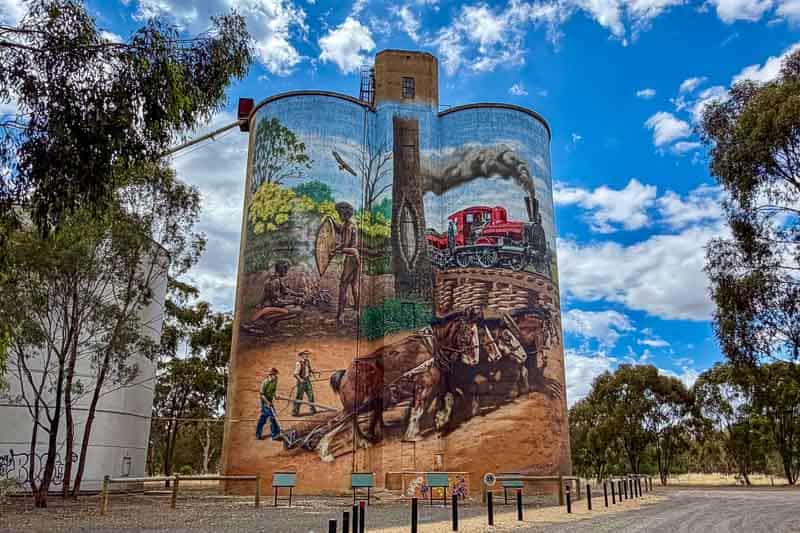
Artist: Tim Bowtell | Year: 2023
Katamatite’s mural combines Indigenous heritage, farming history and native wildlife.
Look for the wedge-tailed eagle, scar tree, early railway engine and horses working on irrigation channels. Together, they tell the story of the district’s development.
14. Lake Boga

Artist: Tim Bowtell | Year: 2023
Lake Boga’s artwork celebrates the town’s fascinating aviation history.
Featuring a Catalina flying boat and aviator George ‘Scotty’ Allan, the mural is a reminder of the important role this area played in Australian aviation and during the Second World War.
15. Lascelles

Artist: Rone | Year: 2017
The enormous portraits at Lascelles feature local farming couple Geoff and Merrilyn Horman, whose families have lived in the district for generations.
The understated, realistic artwork is a lovely tribute to the people who have kept this tiny rural community going.
16. Murtoa

Artist: Smug (Sam Bates) | Year: 2023
Murtoa’s silos feature 30 beautifully detailed birds, inspired partly by the local museum’s taxidermy collection.
One bird glows after dark, representing mental health awareness and recognising Murtoa-born psychiatrist Dr John Cade.
It’s another fantastic example of Smug’s work, and one I’d particularly recommend if you enjoy detailed, realistic artwork.
It is hard to get close to though, so this is one you will have to view from further away.
17. North Geelong

Artist: Sai Neoh | Year: 2024
Located at the historic Federal Mills complex, North Geelong’s silos are covered with colourful native flowers against a dark background.
The artwork contrasts the site’s industrial history with the natural beauty of Australian plants.
18. Nullawil

Artist: Smug (Sam Bates) | Year: 2019
Nullawil’s mural is a favourite among dog lovers, featuring a remarkably lifelike kelpie named Jimmy beside his human companion.
Take a closer look at Jimmy’s collar tag, which includes symbols relating to the town’s name and history.
19. Patchewollock

Artist: Fintan Magee | Year: 2016
The towering portrait at Patchewollock depicts local farmer Nick ‘Noodle’ Hulland. His weathered clothing and relaxed appearance capture the character of Australia’s Mallee farming communities.
It was one of the earliest additions to Victoria’s silo art movement.
20. Picola

Artist: Jimmy Dvate | Year: 2020
Picola’s silo features a detailed scene inspired by the nearby Barmah Forest.
There’s also a little challenge for visitors: the artist has hidden a hook within the painting, referencing the town’s old nickname, ‘The Hook’, when it was the end of the railway line.
21. Rainbow

Artist: Geoffrey Carran | Year: 2025
Rainbow’s silo art project is especially unusual because it includes artwork inside the silo as well as outside.
The exterior celebrates the endangered Mallee emu-wren, while illuminated interior displays and elevated viewing platforms offer something quite different from the usual roadside mural.
Check opening arrangements if you’d like to see inside – sadly it wasn’t open when I was there.
22. Rochester

Artist: Jimmy Dvate | Years: 2018, 2021 and 2024
Rochester has three separate silo art installations, all featuring local wildlife.
The first depicts an azure kingfisher and squirrel glider, the second celebrates the platypus, and the third features a New Holland honeyeater. Together, they highlight the importance of protecting native habitats.
We first visited Rochester when we were staying in Echuca – you could do what we did and visit some of the silos from there.
23. Rosebery

Artist: Kaff-eine | Year: 2017
Two contrasting portraits celebrate the farming community at Rosebery.
One features a young female farmer representing the future, while the other depicts local farmer Len Coffey alongside his horse, reflecting the agricultural traditions of the region.
One of the few murals done by a female.
24. Rupanyup

Artist: Smug (Sam Bates) | Year: 2025
Rupanyup’s original 2017 mural by Julia Volchkova featured two young local sportspeople, Ebony Baker and Jordon Weidemann.
Unfortunately, that artwork deteriorated over time and was replaced by a new mural from Smug in March 2025. Keep this in mind when looking at older trail photographs.
25. Rutherglen

Artist: Ronan Holdsworth | Year: 2025
Titled Birds of Seasons, Rutherglen’s silo artwork celebrates the changing seasons through local birdlife.
Each silo represents a different season, with colours and intricate details referencing the district’s agricultural landscape, goldmining history and natural environment.
26. Sea Lake

Artists: The Zookeeper and Drapl | Year: 2019
Sea Lake’s beautiful mural depicts a young girl swinging from a mallee tree, overlooking nearby Lake Tyrrell. A wedge-tailed eagle and emus complete the scene.
The artwork also incorporates references to the Boorong people’s connection with the land and night sky.
27. Serviceton

Artist: Jack Fran | Year: 2025
Serviceton’s mural tells a story about the historical surveying error that created a disputed stretch along the South Australian–Victorian border.
The artwork also recognises the town’s important railway heritage, making it particularly interesting for history lovers.
28. Sheep Hills

Artist: Adnate | Year: 2016
Sheep Hills features a beautiful mural celebrating the region’s Indigenous heritage.
It depicts Wotjobaluk Elder Aunty Regina Hood alongside two young people, Savannah Marks and Curtly McDonald, symbolising the connection between generations and their continuing relationship with Country.
29. St Arnaud

Artist: Kyle Torney | Year: 2020
Titled Hope, St Arnaud’s mural celebrates the town’s goldmining past. It features a pioneering family representing the hopes of miners searching for gold, women providing for their families and children looking towards a better future.
30. St James

Artist: Tim Bowtell | Year: 2019
St James has an interesting connection to one of Australia’s biggest supermarket chains.
Its mural celebrates the town’s grain-growing history and George James Coles, who grew up in St James before going on to establish the Coles retail empire.
31. Tungamah

Artist: Sobrane Simcock | Years: 2018–2019
Tungamah’s cheerful silos feature brolgas, a kookaburra, galahs and other colourful birds. Originally painted in 2018, additional birds were added the following year.
The artwork helped establish the North East Victorian Silo Art Trail.
32. Waaia

Artist: Tim Bowtell | Year: 2025
One of the newer additions, Waaia’s mural celebrates the region’s dairying and agricultural history.
It features Friesian cows, local identity Bill Martin carrying wheat sacks, an early passenger train and crows representing the town’s name.
33. Walpeup

Artists: Julian Clavijo and Camilo Delgado | Year: 2023
Walpeup’s moving mural honours Harold Thomas Bell, a local teenager who enlisted in the First World War under a false name and age.
He was just 16 when he died from wounds suffered at the Battle of Beersheba in 1917.
Explore More Silo Art in Australia
Victoria isn’t the only Australian state where you can find incredible silo art. Communities across the country have transformed ordinary grain silos into enormous works of art, each telling a different story.
If you’re planning a road trip elsewhere in Australia, take a look at my other silo art guides:
- Silo Art in South Australia – Discover the colourful silos scattered across regional South Australia.
- Silo Art in Western Australia – Explore the impressive artworks along Western Australia’s silo art trails.
Both are fantastic ways to explore regional Australia and discover towns you might otherwise drive straight past.
My Melbourne to Adelaide Silo Art Road Trip Itinerary
While we spent three days concentrating on Victoria’s silo art, it was actually part of a longer five-day road trip from Melbourne to Adelaide.
Here’s how we planned our route.
Day 1 – Melbourne to Geelong and Ballarat
We started with the silo art in North Geelong and an afternoon exploring the city before continuing to Ballarat, where we stayed overnight.
Day 2 – Sovereign Hill and North-East Victoria
We spent the day exploring Sovereign Hill in Ballarat before heading north-east towards Shepparton, where we stayed for the night.
Day 3 – North-East Victoria Silo Art
Today was all about silo art, visiting the towns around Shepparton and north-east Victoria.
We finished the day by driving to Bendigo, where we stayed overnight.
Day 4 – Wimmera Silo Art
Leaving Bendigo, we spent the day exploring the silo art locations across the Wimmera region, eventually making our way to Dimboola for the night.
Day 5 – More Wimmera Silo Art and Home to Adelaide
Our final day was another big one, visiting more silo art locations across the Wimmera before making the long drive back to Adelaide.
Would I Recommend This Itinerary?
Absolutely, although it’s worth knowing that we packed a lot into those three silo art days!
We spent plenty of time driving, and our focus was mostly on seeing the artworks rather than exploring every town in detail.
If you have more time, I’d recommend slowing down and allowing a few extra days. There are some lovely country towns and interesting attractions along the way that deserve more than a quick visit.
But if you’re short on time and want to see as much silo art as possible, it certainly shows how much you can fit into a few days.
Tips for Driving Victoria’s Silo Art Trail
After spending three days driving around Victoria looking for silo art, I’ve picked up a few tips that might help you plan your own trip.
If you’re planning to explore the Wimmera and Mallee silo art locations, look out for suggested driving routes that link several of the artworks together.
I came across this sign during our road trip, showing some suggested routes through the western part of Victoria. It’s a handy starting point if you’re not sure how to organise your own itinerary.

Don’t Underestimate the Distances
Victoria might look small on a map, but the silo artworks are spread over a huge area.
Some are only a short drive apart, while others require a significant detour. If you’re trying to visit as many as possible, expect to spend plenty of time behind the wheel.
You could easily turn this into a week-long road trip and spend more time exploring the towns along the way.
Plan Your Route Before You Leave
The silos aren’t all on one continuous trail, despite the name.
I recommend plotting the locations on Google Maps before you leave and grouping them into geographical areas. This will help minimise backtracking and unnecessary driving.
The Wimmera and Mallee have the greatest concentration of silos, so they’re a good starting point if you only have a few days.
Don’t Expect Facilities at Every Stop
Some silo art locations are in reasonably large towns, but others are in tiny communities with very few facilities.
Don’t assume you’ll find a cafe, public toilet or petrol station at every stop.
Keep your fuel topped up, carry plenty of water and have some snacks in the car, particularly if you’re travelling on weekends when smaller businesses may be closed.
Allow Time for More Than Just the Silos
It’s tempting to drive into town, take a photo and head straight to the next mural, particularly if you’re trying to see as many as possible.
But part of the appeal of this road trip is discovering the towns themselves.
If you’ve got time, stop for lunch, visit a local attraction or simply take a walk along the main street.
Spending a little money in these communities is also a great way to support the towns that have invested in bringing the artwork to life.
Check Access and Lighting
Most of Victoria’s silo artworks can be viewed for free from public areas, but not every site has the same access arrangements.
Some silos are still part of working grain facilities, so pay attention to signs and don’t enter restricted areas.
A few locations have special lighting or glow-in-the-dark features. If you’re keen to see these, check the arrangements before planning an evening visit.
Be Prepared for Country Driving
Many of the roads between silo art locations are quiet country highways, but that doesn’t mean you can switch off.
Watch for trucks, farm machinery and wildlife, particularly around dawn and dusk.
Mobile reception can also be patchy in rural areas, so downloading an offline map before leaving is a good idea.
And if you’re travelling in summer, be prepared for some very hot days. There’s not always much shade around the silos!
Check for New Silo Art Before You Go
Victoria’s Silo Art Trail is still growing, with new artworks being completed and older ones occasionally replaced.
Before setting out, check the Australian Silo Art Trail website for the latest locations.
You might discover there’s a new mural to add to your itinerary.
Why Victoria’s Silo Art Trail Is Worth Exploring
After three days of driving around country Victoria, I can understand why the Silo Art Trail has become such a popular road trip.
The artwork is incredible, and completely different, but for me, it’s about more than just the paintings.
It’s an excuse to get off the main highways, explore little country towns and see parts of Australia that don’t always make it onto the usual tourist itineraries.
Some of these places are probably somewhere I would never have visited if it wasn’t for the silo art, and that’s a big part of what makes this trail so worthwhile.
Whether you visit a handful of silos or set yourself the challenge of seeing all 33, it’s a great way to explore regional Victoria.
And with new murals still being added, there’s always another reason to head back.
TRAVEL PLANNING ESSENTIALS
Flights – Book direct with the airline, always.
Book accommodation – My go to is Booking.com
Hire a rental car – DiscoverCars.com is where I search many car rental companies in one place
Get travel insurance – I use CoverMore for my insurance.
Pick up an eSIM – My eSIM of choice is Airalo
Book activities, tours & attractions – I use a few different websites for this. Viator, Get Your Guide and Klook are my first options.
Stay safe with a VPN – I use NordVPN to keep me safe online
Manage your money – I use Wise and ING (Australia) for my travel accounts.
