
Iceland isn’t shy when it comes to waterfalls. With about 10,000 of them scattered across the country, it can feel like every turn in the road reveals another one.
During our road trip, we visited just 15 of the waterfalls in Iceland, yet we saw countless more from the car as we drove.
And honestly? We still barely scratched the surface.
But if you’re planning your own Iceland adventure and want a starting point, these are the five waterfalls I think you absolutely shouldn’t miss.
They’re iconic, relatively easy to reach on a classic Ring Road or South Coast itinerary, and each one brings something different to the table – whether it’s power, colour, scale or that unforgettable “wow” factor.
This article may contain affiliate links. This means that if you make a purchase after clicking on a link, I may receive a small commission. Read the full disclaimer here.

Brúarfoss – The Bluest Waterfall in Iceland
Brúarfoss was the first waterfall we visited in Iceland, and it set the bar high. It’s not one I had heard a lot about, which is surprising, because I think it was my favourite of the whole trip.
It’s just off the Golden Circle and is known for one thing above all else – its striking blue water. It really does stop you in your tracks when you first see it.
There is a track in from the main road on the west side of the river to a small carpark – put Brúarfoss Parking into Google Maps. This meant we only walked a short way to the waterfall.
You will have to pay for parking here. We used the Parka App, and with their transaction fee, it cost us 836kr.
We then crossed over the bridge and walked down to see Midfoss and Hlauptungufoss, returning back along the same path. It’s about a 3km return walk.
The alternative is to walk to Brúarfoss from the Eastern side, either from the main road (the Brúará Trail) or from where there are several cottages and accommodation options.
The walk is straightforward, right along the river and takes you past two smaller falls, Midfoss and Hlauptungufoss.
They’re a nice warm-up and break up the walk well. The path can get muddy, so sturdy shoes are helpful, but it’s not a difficult trail.


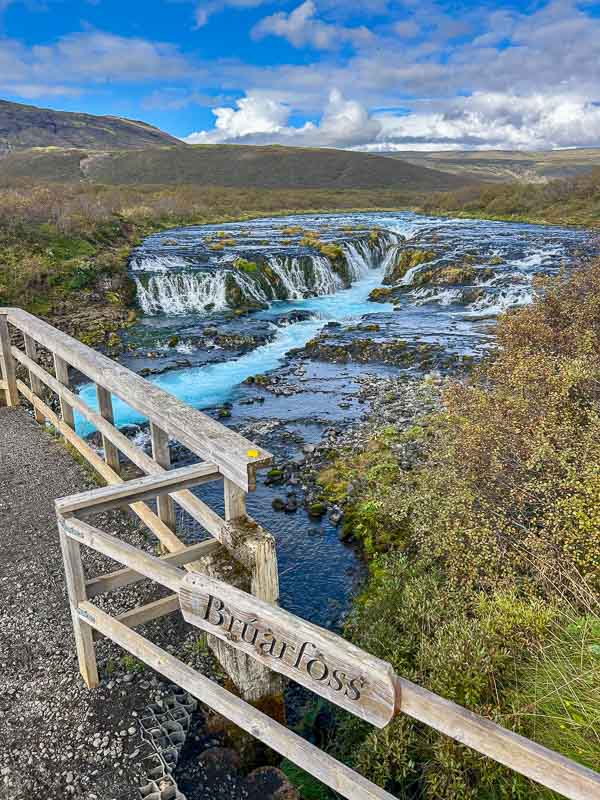
Most people view Brúarfoss from the small wooden bridge directly above the falls. It gives you a great angle to see the blue water funnel through the narrow channel before dropping away.
If you like taking photos, allow a bit of extra time here – you’ll probably try a few different viewpoints before you’re happy.
Compared to the larger Golden Circle stops, the crowds here are usually smaller. There would have been less than 20 people here during our visit.
Arriving earlier in the morning or later in the day gives you more space and a calmer feel.
My tips? Wear decent shoes, be prepared for mud, and take your time on the walk in. Brúarfoss is a simple stop, but a memorable one.

Gullfoss – A Golden Circle Classic
Gullfoss is one of the big names on the Golden Circle, and once you’re standing there, it’s easy to see why.
This huge, two-tiered waterfall sends an enormous volume of water thundering into a narrow gorge, and the sheer power of it is impressive from the moment you arrive.
There are two main viewpoints – the upper viewing area, which gives you a great overview of the whole cascade, and the lower path, where you can get much closer to the action.
In between there are lots of other places to stop for photos too.
If you have time, visit both viewpoints. They each give a slightly different feel, and together they help you appreciate the scale of the falls.
Because it’s such a well-known stop, Gullfoss can get busy, especially in the middle of the day, which is when we were there. There were hundreds of people here. It was busy, but it’s also a large area, so it was okay.
Early morning or late afternoon tend to be quieter, and the light is often better for photos. It’s also worth noting that the spray can be strong when the wind picks up, so a rain jacket is handy even on a sunny day.


Access is easy with large car parks, clear paths and a visitor centre with toilets and food. Parking here is, surprisingly, free.
There are stairs to navigate here, but the car park and visitor centre are right near the falls, so no long hike in needed.
You don’t need long here to enjoy it, but give yourself at least 30-45 minutes so you can walk to both viewing areas without rushing.
Gullfoss is one of those places that simply belongs on an Iceland itinerary. It’s powerful, easy to reach, and a great way to understand just how dramatic Iceland’s landscape can be.

Seljalandsfoss – The One You Can Walk Behind
Seljalandsfoss is one of the most famous waterfalls in Iceland, and the reason is simple – you can walk right behind it.
Standing in that cave-like space with water thundering down in front of you is a pretty cool experience and one you shouldn’t skip.
The path behind the waterfall is short but rocky and slippery, so good shoes are important.
And you will get wet, no matter the weather. A rain jacket is essential, and I’d also keep your phone or camera protected because the spray hits from every direction once you step behind the falls.
It’s worth taking the time to walk the full loop, not just duck in and out. Each angle gives you a different view of the curtain of water, and when the light catches it, the whole scene feels a bit magical.
There is a small shop, coffee van and toilets here, but not a full visitor centre. Parking cost us 1000kr.


Most people stop here quickly, but it’s worth continuing the short walk along the path to Gljúfrabúi, another waterfall tucked inside a narrow canyon.
To see it properly you’ll need to step into the creek and walk a few metres into the slot – again, waterproof shoes or at least a willingness to get wet (read – soaked!) will help. It’s a fun little add-on and far less crowded.
Because Seljalandsfoss is right on the main South Coast route, it gets very busy in the middle of the day. Visiting early or late gives you more room and makes the walk behind the falls far calmer.
It was first up on our itinerary for the day and there were only a handful of people there.
If you’re creating an Iceland itinerary that includes the South Coast, this one is a must-do. Just accept that you’ll come back rather damp and you’ll enjoy it even more.

Skógafoss – Big, Bold and Impossible to Miss
Skógafoss is one of those waterfalls that you hear long before you see it. It drops straight down from a flat cliff edge with so much force that you can feel the mist from a surprising distance.
It’s simple, dramatic and incredibly easy to visit, which is why it’s such a standout on the South Coast.
From the car park it’s only a short, flat walk to the base of the falls. Parking at Skógafoss cost us 1088kr through the Parka app.


You can get as close as you like – which is a great option for that right-in-front-of-a-waterfall photo, but be prepared to get wet from the spray – a waterproof jacket is handy here too if you’re planning to get close.
On sunny days you’ll often see a rainbow forming at the base, which is a fun bonus if you’re taking photos.
If you’re up for a climb, there’s a staircase of about 525 steps leading to a viewing platform at the top. It’s a solid workout, but the view looking down over the falls and across the landscape is worth it.
Once you’re at the top, you can also continue along the trail beside the river, where you’ll find dozens of smaller waterfalls.


You don’t need to walk far to enjoy this section – we saw people much further along than where we went. We loved seeing some Icelandic sheep up close as they wandered across the path.
Crowds here are fairly constant because Skógafoss sits right on the main route toward Vík, but the area is spacious so it rarely feels cramped. Early mornings are the quietest time, and the light is usually softer too.
Skógafoss is one of those places that captures the best of Iceland in one stop – easy access, big scenery and a view you won’t forget.

Dettifoss – Europe’s Most Powerful Waterfall
Dettifoss is a completely different waterfall experience. While many Icelandic falls are known for their colour or graceful shape, this one is all about raw power.
As you walk in, you can hear the roar long before you see the water, and by the time you reach the edge, the force of it is incredible.
We visited from the east side, which gives you the closest and most dramatic angles. You’re standing right near the cliff edge with a full view of the water smashing into the canyon below.
It feels rugged and wild, and it’s easy to understand why this side is such a favourite for photographers.
The access road on the east side is rougher and usually only open in the warmer months. The path from the car park is short, but uneven and exposed to the wind.


The spray from Dettifoss can travel a long way, so waterproof gear is useful even when it looks dry – I can’t confirm how far the spray goes, it was raining heavily during our visit so we were wet anyway.
One thing worth mentioning is safety. When we visited, we saw people stepping over the ropes and walking right out to the cliff edge for photos – in wet, windy conditions.
It’s extremely dangerous. The rocks are slippery, the wind is unpredictable and there’s nothing to stop a fall. Please don’t be that tourist.
The views are incredible from the marked paths, and staying behind the barriers keeps everyone safe.
If you have time, you can pair Dettifoss with nearby stops like Ásbyrgi Canyon, Hverir, or Goðafoss as part of a Diamond Circle day trip. It makes for a full but very rewarding loop.
Dettifoss may not be the prettiest waterfall in Iceland, but it’s one of the most unforgettable. Seeing it from the east side gives you a real sense of its power – safely enjoyed from solid ground.
Iceland is full of waterfalls – more than you can ever hope to see in one trip – but these five stood out for us.
Each one offers something different, from the bright blue water at Brúarfoss to the sheer power of Dettifoss in the north.
We visited plenty of others and spotted even more from the road, yet these are the ones we still talk about.
If you’re planning an itinerary, it’s worth making space for at least a few of them.
They’re easy to reach, each visit only takes a short amount of time, and they really show off the variety of Iceland’s landscape.
Pack good shoes, expect a bit of spray, and enjoy every stop – chasing waterfalls in Iceland is one of those simple travel joys you simply shouldn’t miss.
TRAVEL PLANNING ESSENTIALS
Flights – Book direct with the airline, always.
Book accommodation – My go to is Booking.com
Hire a rental car – DiscoverCars.com is where I search many car rental companies in one place
Get travel insurance – I use CoverMore for my insurance.
Pick up an eSIM – My eSIM of choice is Airalo
Book activities, tours & attractions – I use a few different websites for this. Viator, Get Your Guide and Klook are my first options.
Stay safe with a VPN – I use NordVPN to keep me safe online
Manage your money – I use Wise and ING (Australia) for my travel accounts.
